
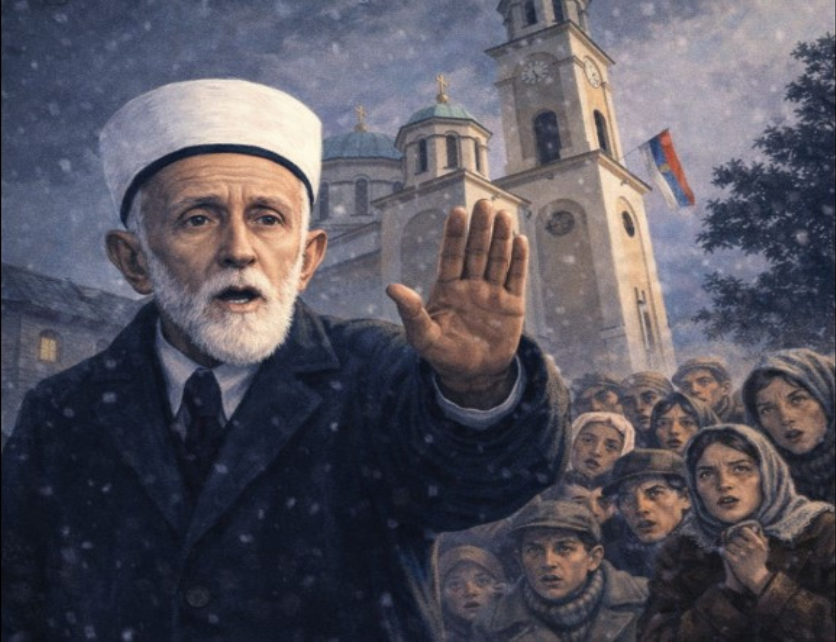
Righteous of the Second World War - Tuzla Mufti Kurt
June 21st of this year marked 63 years since the death of Muhamed Šefket ef. Kurt (Travnik, 1879 - Tuzla, 1963), a Bosniak theologian and Mufti of Banja Luka and Tuzla, who is credited with saving the lives of Tuzla Serbs during the dark era of the Second World War.
Who is Mufti Kurt anyway and what are his merits?
He comes from a prominent Mostar family but was born in Travnik, the place of his father's service, and was educated in Mostar, Sarajevo, Istanbul, and Damascus. He was appointed Mufti of Banja Luka in 1914, and later moved to Tuzla, where he served as Mufti from 1925 to 1933, and retired in 1936. With the establishment of the so-called NDH and the first crimes, resolutions of the Muslim population against reprisals towards Serbs, Jews, Roma, and political dissidents emerged, so on November 11, 1941, the Tuzla Resolution was voted on. Its original text was written in an extremely harsh tone, but it was decided not to send it, but to send a delegation to Zagreb to protest orally to the NDH Government. At the same time, the Ustaše authorities in Tuzla intended to demolish the Cathedral of the Dormition of the Most Holy Mother of God on Christmas Eve 1942; along with the demolition of the Tuzla Orthodox church, the Ustaše intended to commit a mass murder of civilians of Serbian ethnicity. Therefore, the infamous district head from Brčko, Vječeslav Montani, famous for his crimes, was called to come with his Ustaše to Tuzla, in order to plant explosives in the Orthodox church on Christmas Eve, when it would be full of believers. By destroying the church and killing those present, they would proceed to destroy the Serbian town and drive the entire remaining surviving population into camps.
Information about the Ustaše plans reached Mufti Kurt, who, having gathered prominent Tuzla residents, drafted a resolution that was immediately delivered to the German occupation forces, while individual actions were taken by prominent local Croats Ante Kamenjašević, Jure Begić, and others.
Na takva upozorenja reagovao je i potpukovnik Wist, njemački komandant grada, dok su po Tuzli istaknuti plakati s upozorenjem “da nitko nikoga ne smije zlostavljati, oduzimati ili rušiti tuđu imovinu i dirati živalj koji slavi Badnjak i Božić”.
After the resolution was delivered to the German occupation forces, Šefket ef. Kurt and Hadži Hasan-aga Pašić, a former mayor of Tuzla, led a delegation that met in Zagreb with the Minister of Internal Affairs of the Independent State of Croatia, Andrija Artuković. As the conversation was not pleasant at all, and at one point, according to witnesses, Artuković cocked his revolver and went towards Kurt and Pašić. The remaining members of the delegation of Tuzla notables told Artuković that the whole of Tuzla would rise against the NDH authorities if he killed Kurt and Pašić, which deterred Artuković from his intention.
Otherwise, the Ustaše regime in Tuzla, according to an original report from June 1943, viewed the “passivity” of Islamic officials negatively, while Muhamed Šefket efendija Kurt himself was marked in that report as a “secret enemy of the order” and an “old Byzantine-Serb”!
Šefket ef. Kurt remained in Tuzla until his death; he passed away on June 21, 1963, at the age of 84. Ten thousand citizens of Tuzla and the surrounding area, members of all ethnic and religious communities, came to the funeral, and a great speech was given by the Tuzla priest Đorđe Jovanović. The writer Meša Selimović testifies in his memoirs that the intimate and unusual request of priest Jovanović, the “red priest” who survived the Dachau concentration camp, was accepted: that he be the one to descend into the efendi's grave before him, receive the coffin with the efendi's body, and place it in the grave, as his great friend and admirer, which was respected.
Trojica sinova Šefket ef. Kurta, Fadil, Asim i Enver poginuli su kao pripadnici partizanskih jedinica u Narodno-oslobodilačkom ratu, dok su tri sina (Fadil, Kemal i Enver) diplomirali pravo na zagrebačkom sveučilištu. Porodica Kurt je muftijinu bogatu ličnu biblioteku poklonila Gazi Husrev-begovoj biblioteci u Sarajevu, dok ulica pored Mejdanske džamije u Tuzli danas nosi ime Šefketa ef. Kurta. Godine 2020. snimljen je dokumentarni film “Efendijin zavjet”, koji ima za cilj da podsjeti na muftijin herojski čin u spašavanja tuzlanskih Srba, koji evo i ovim radom približavamo javnosti.
Righteousness remains - and the righteous are remembered!
Brčko, May 2026. Prof. Dr. Milomir Čodo/Prof. Dr. Dževad Drino